Advance Steel can model simple concrete walls with the Wall tool (Home tab > Objects panel > Concrete Beam > Wall). Pick the start and end points of the wall, press Enter, then set the height, thickness and material in the dialog. For a flat, slab-like wall, use Polygonal Wall.
Steel almost always has to fit around something else: a concrete wall, a masonry wall, a foundation. Modeling those walls lets you see what your steel connects to and check for clashes.
Contents

Where is the Wall tool?
Home tab > Objects panel > Concrete Beam > Wall
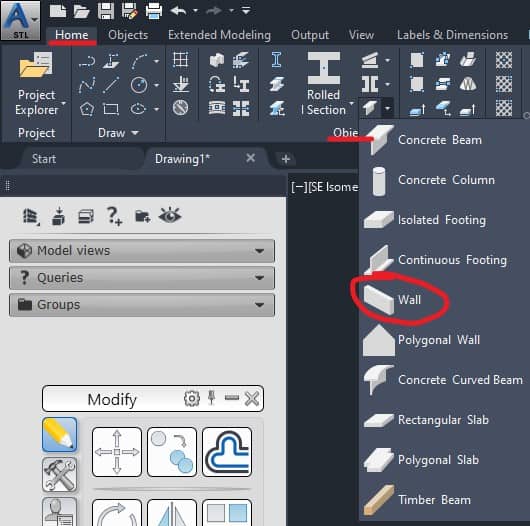
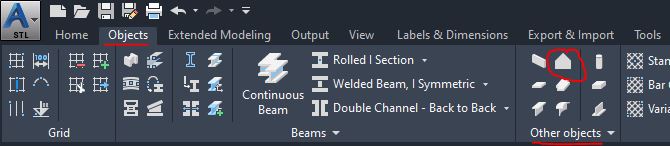
Objects tab > Other Objects panel > Wall

How do I place a wall in Advance Steel?
Start the tool and pick the first point of the wall, then the next point. For a single wall, press Enter after the second point. For several segments, keep picking end points until you’re done, then press Enter. Each segment comes in as a separate wall.
When you press Enter, the dialog opens so you can adjust the walls.
Command line options while you’re placing walls:
CLcloses the loop back to the first point.Uundoes the last segment.CHchanges the UCS for the next segment.
What do the wall settings do?
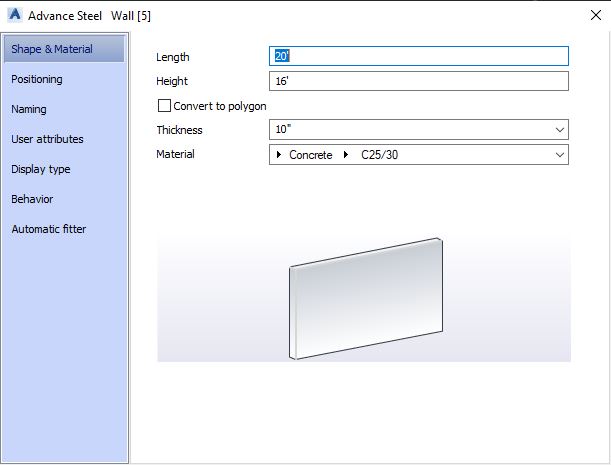
- Length. With one segment, shows its length. With several segments of different lengths, it’s blank. Type a value and every wall changes to that length.
- Height. The wall height.
- Convert to polygon. Turns the wall into a polygonal element, so you can drag the top corners independently of the bottom ones (handy for a sloped top). Unchecked, dragging an end point just changes the length.
- Thickness. The wall thickness.
- Material. Pick it from the list.
What is a polygonal wall?
The Polygonal Wall tool makes a wall that lies flat on the XY plane of the current UCS, more like a slab. Start the tool, pick all the points around its outline and press Enter. The same dialog opens, with the options described above.
Home tab > Objects panel > Concrete Beam > Polygonal Wall
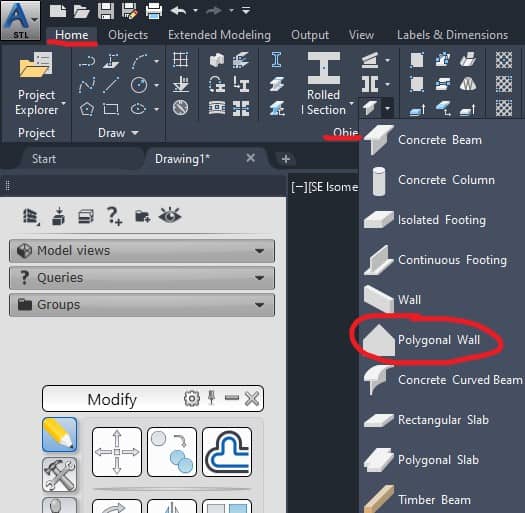
Objects tab > Other Objects panel > Polygonal Wall
Why model walls in a steel model?
- Connections. Embed plates, ledger angles and anchor bolts need something to attach to. Seeing the wall makes it easier to place them right.
- Clashes. Steel that runs into a wall shows up when you check the model or review it in Navisworks.
- Drawings. Erection drawings are easier to read when the walls are shown for reference.
Keep the walls simple. They’re reference for the steel, not a concrete model. Take the wall size and location from the architectural or structural drawings.
What to do when the wall is wrong
- The wall is on the wrong side of the line. Pick the points in the other direction.
- Changing the length moves the wrong end. Uncheck Convert to polygon if you just want to change the length.
- The wall shows in the BOM. Check how your BOM template handles concrete objects.
For concrete beams, see Placing a concrete beam in Advance Steel.