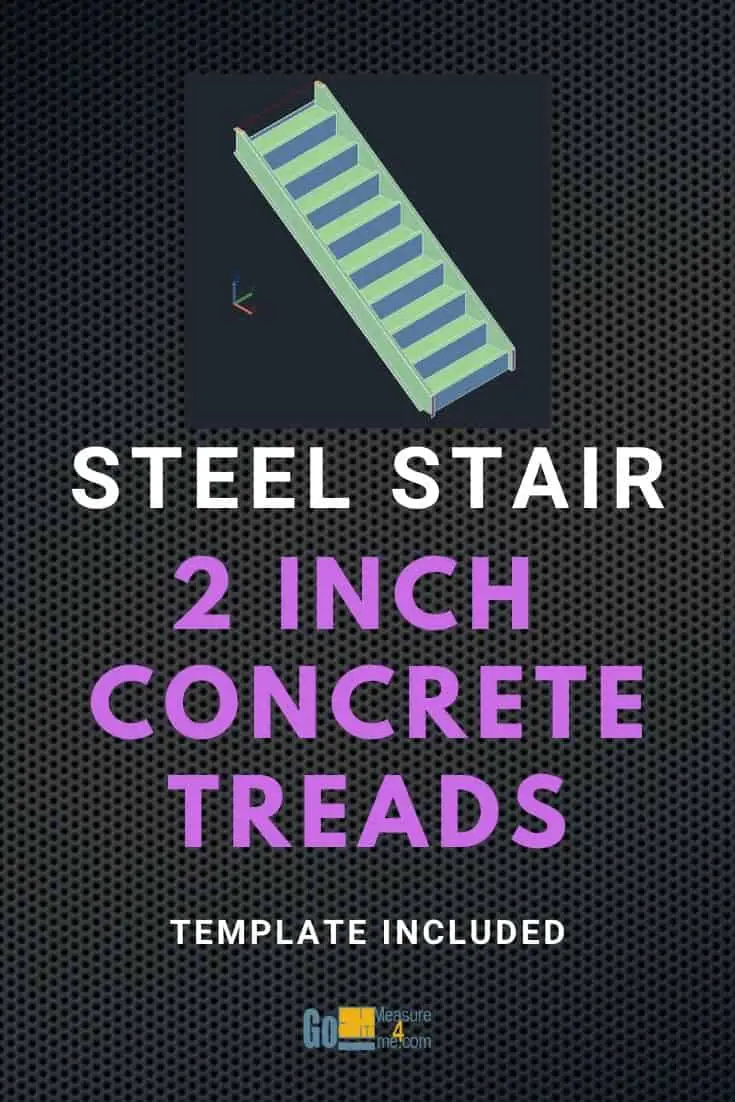
To model a concrete-filled steel pan stair in Advance Steel, create a straight stair with the Stair tool, then load the 2″ Concrete Pan MC10x8.4 template from Properties > Library. After that you only trim the pans and stringers at the top and bottom with UCS cuts and add the stringer plates. You can download the template below.
What is a concrete-filled pan stair?
It’s a steel stair where each tread is a bent steel pan that gets filled with concrete on site. The steel shop builds and erects the stair with empty pans, and the concrete goes in later, usually with the floor pours. The pans and stringers have to carry construction loads before the concrete is in, which is one reason the stair should be designed by an engineer.
Pan stairs with concrete-filled treads are one of the most common stairs in commercial buildings, and they take a while to model from scratch. So I made a template. This post shows how to use it to build a steel stair with 2″ concrete treads on MC10x8.4 channel stringers. In the example we’ll make 9 treads and 10 risers at 7″. Treads are 10″ deep, which is below the 11″ IBC minimum for most buildings (more on that below), so change it in the stair dialog for a real job.
Stair geometry (riser, tread, width, headroom, handrails) is set by code. The numbers here are an example, not a design. Check your local code and the architect’s drawings before you build from this example.
Download the template
Download the template file for free, unzip it and open the file.
Video tutorial

How do I model a pan stair in Advance Steel?
With the file open, delete the existing stair and make a new one.
- Go to Home > Extended Modeling and click the Stair icon.
- When asked how to create the stair, choose the default option, 0 (start and end points).
- Pick the start point: where the top of the first riser will be, 1 1/2″ to the side. That 1 1/2″ is the flange width of the MC10x8.4 stringer.
- Pick the end point of the stair, again allowing for the stringer.
- When asked how to align the stair, type 2 and press Enter.
The stair appears in a second or two.
Load the template settings
In the Stair dialog, go to Properties > Library and choose 2″ Concrete Pan MC10x8.4. The stair updates to a standard pan stair with 2″ concrete treads.
How do I trim the pans and stringers?
Trim the bottom pan
- Put the UCS at the bottom of the stair and rotate it so the XY plane is parallel to the face of the stringer.
- In the Advance Steel tool palette, Features tab, pick Rectangular Contour, 2 Points.
- Pick two points around the part of the pan you want to remove.
Cut the bottom of the stringers
- Move the UCS so it’s 1 1/2″ from the face of the first riser, and rotate it so the XY plane is perpendicular to the stringers.
- In Features, pick Shorten at UCS, select both stringers and press Enter.
- Rotate the UCS so the XY plane lies flat on the floor.
- Run Shorten at UCS again on both stringers.
Trim the top pan
- Put the UCS where you want to cut the pan.
- Use Rectangular Contour, 2 Points again: select the pan, then pick two points around the part to remove.
Cut the top of the stringers
- Put the UCS where the stringers need to be trimmed at the top and rotate it into position.
- Run Shorten at UCS on both stringers.
- Put the UCS at the very top of the stair, rotate it into position, and run Shorten at UCS on both stringers again.
How do I add the stringer plates?
Last step: the plates at the top and bottom of the stringers.
- Move the UCS to the top of the stringer where the plate goes.
- Go to Home > Objects and pick Rectangular Plate, 2 Points.
- Pick two points. In the dialog, set the plate thickness.
- Copy the plate to the other stringer.
Make the vertical plates at the bottom of the stringers the same way, with the UCS XY plane set vertical. Then copy the plate to the other side.
What mistakes should I avoid on pan stair drawings?
- Using the example numbers on a real job. Take the riser and tread from the architect’s drawings. The 10″ treads in this example are below the 2021 IBC minimum for most buildings: section 1011.5.2 calls for risers of 4″ to 7″ and treads of at least 11″. The 10″ tread is only allowed in exceptions like Group R-3 and inside R-2 dwelling units. Change the tread depth in the stair dialog before you use the template on a commercial job.
- Forgetting the concrete. Show the fill depth and who places the concrete on the drawings, so nobody expects the steel shop to do it.
- Not checking the nosing. The nosing and the top of concrete set the walking surface. Check the finished riser heights, not just the steel.
- Skipping the landing connections. The stringer plates have to match what they bolt or weld to. Check the landing or slab edge before you send the stair.
For how stairs work in Advance Steel in general, see the stairs in Advance Steel guide.