
To create a portal frame in Advance Steel, click Portal/Gable Frame on the Home tab (Extended Modeling panel), pick the base points of the two columns and the height of the apex. Advance Steel builds the columns and rafters, and a dialog box opens where you set the span, eave height, roof slope and sections. The Mono-Pitched Frame tool next to it does the same for a frame with one flat or sloped rafter.
Below is every tab of the dialog explained, how gable frames differ, how to build a mono-pitched frame, how to connect the members, and what to check when the frame doesn’t come out right.
What is the difference between a portal frame and a gable frame in Advance Steel?
Both come from the same tool, and you switch between them with Type on the Properties tab:
- A portal frame is two columns and the rafters between them. It’s the typical interior frame of a steel building.
- A gable frame adds gable posts between the rafters and the ground, which is what you need at the end walls of a building. That’s why the Gable Section and Gable Distances tabs only show up for gable frames.
A frame from this tool is made of:
- Columns
- Rafters
- A connection box (joint box). If you delete this box, the frame explodes into individual pieces.
How do I create a portal frame in Advance Steel?
You can start the tool from the ribbon in two places:
Home tab > Extended Modeling panel > Portal/Gable Frame
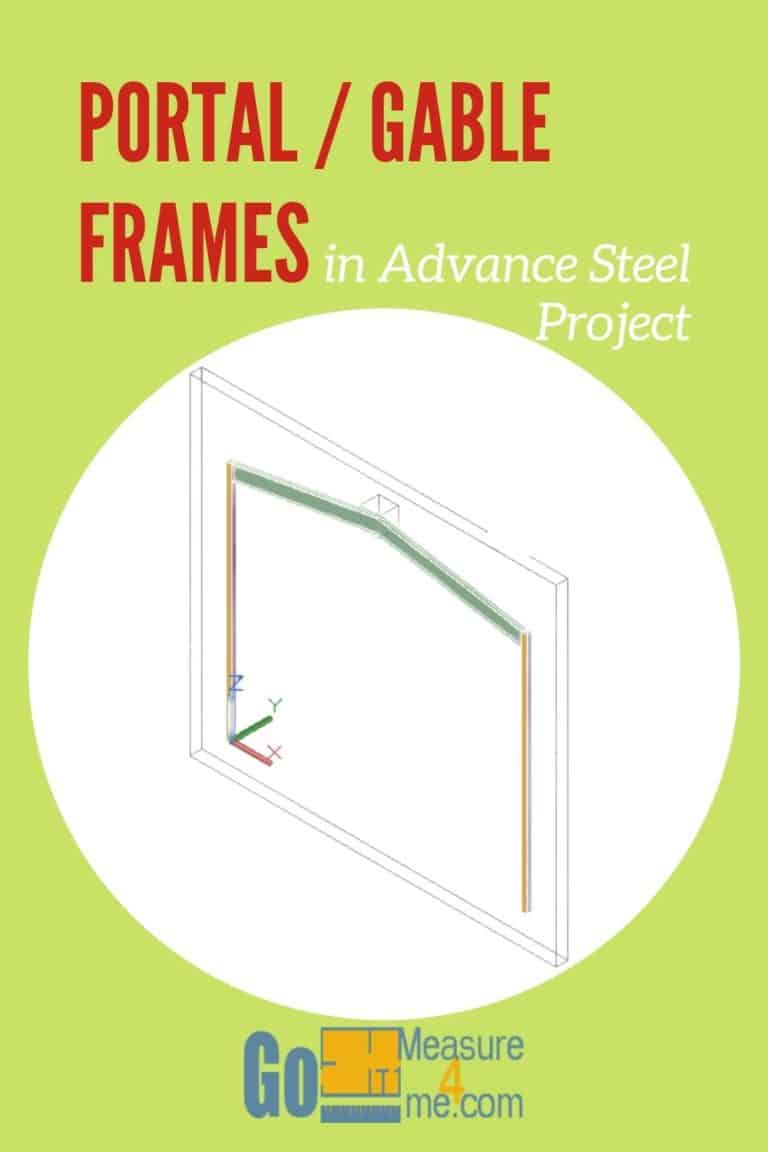

or Extended Modeling tab > Structural Elements panel > Portal/Gable Frame

The tool asks for the base point of the first column, the base point of the second column, and the height of the apex. After you pick those points, a dialog box opens where you can adjust everything about the frame.
What does each tab in the Portal/Gable Frame dialog do?
Properties tab
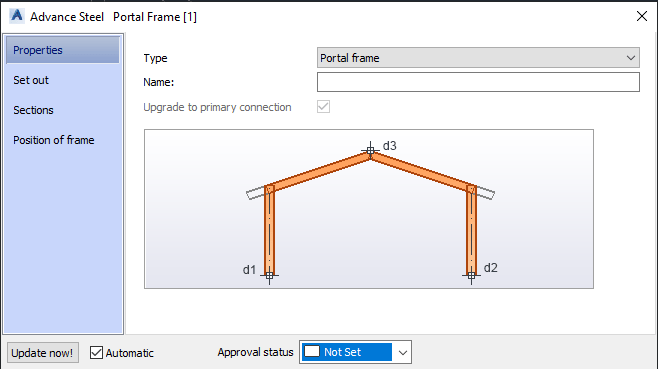
Type: choose a portal or a gable frame.
Name: enter a name for the frame.
Set Out tab: span, height and slope
This is where you set the frame size:
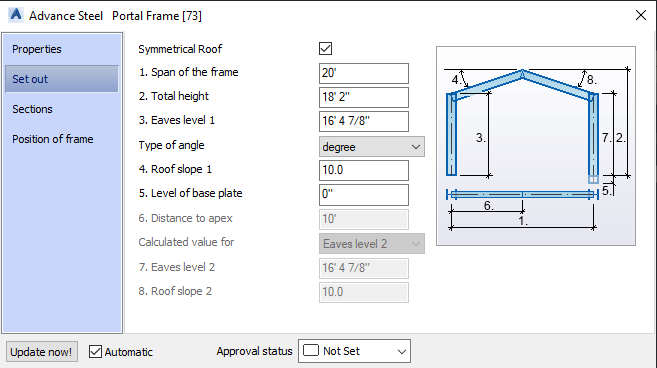
Symmetrical Roof: on by default. Both sides get the same eave height and slope. Uncheck it to make an asymmetric frame.
- Span of the frame: calculated from the points you picked. You can change it here.
- Total height: from the bottom of the columns to the apex.
- Eaves level 1: the height of column 1. On a symmetrical frame, column 2 gets the same value.
- Roof slope 1: the slope of side 1. On a symmetrical frame it applies to side 2 too. Use Type of angle to enter it in degrees or as a percentage.
- Level of base plate: if the frame sits on base plates, enter the plate thickness here. The columns get shorter by this amount.
- Distance to apex (asymmetric frames only): the distance from the first column to the apex.
- Eaves level 2 (asymmetric frames only): the height of column 2.
- Roof slope 2 (asymmetric frames only): the slope of side 2.
Calculated value for (asymmetric frames only): pick which value on the second side is calculated, the height of column 2 or the slope of that side.
Sections tab: column and rafter sizes
Here you pick the sections for the columns and rafters.
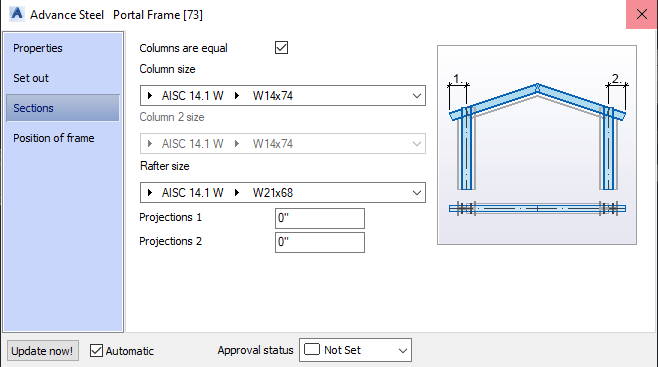
- Columns are equal: on by default, so both columns get the same section.
- Column size: the column section.
- Column 2 size: the section for column 2 when “Columns are equal” is unchecked.
- Rafter size: the rafter section type and size.
- Projections 1 and Projections 2: the overhang on each side.
Position of the Frame tab
This tab sets where the columns and rafters sit relative to the points you used to define the frame.
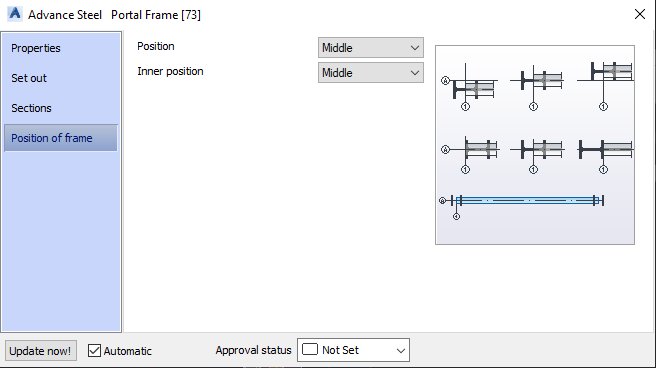
- Position: columns and rafters to the left, right or middle of the frame’s system axes.
- Inner position: columns and rafters on the inside, outside or middle of the frame’s system axes.
Gable Section tab
You only get this tab when you create a gable frame.
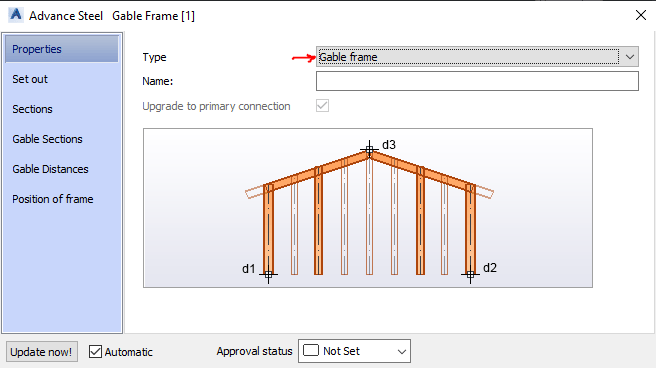
Here are the options for the gable frame:
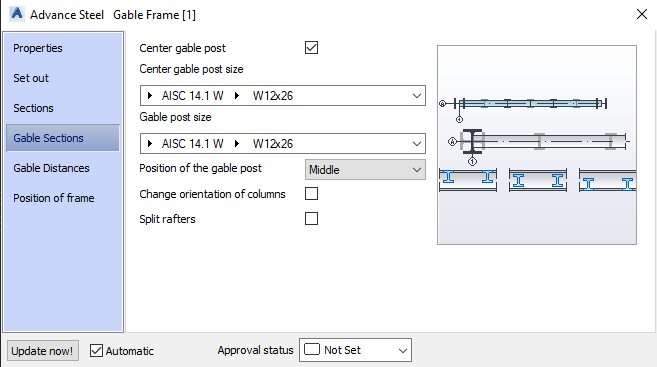
- Center gable post: adds a post at the center of the frame.
- Center gable post size: available when “Center gable post” is checked. The section type and size of the center post.
- Gable post size: the section type and size of the other gable posts.
- Position of the gable post: middle, inside, or outside flush with the columns or frame.
- Change orientation of columns: rotates the columns 90 degrees.
- Split rafters: splits the rafters where the gable posts’ system axes meet them.
Gable Distances tab
Also for gable frames only. This is where you set the number and spacing of the gable posts.
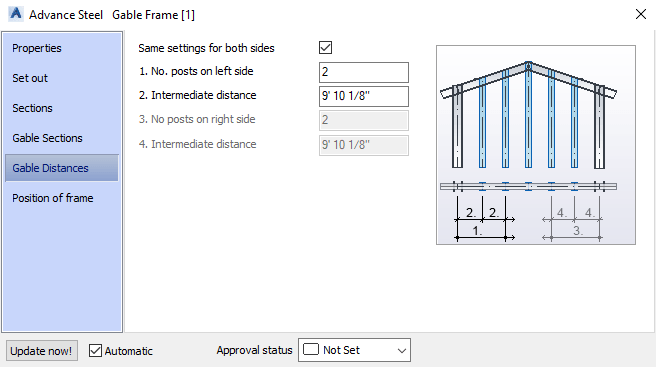
- Same settings for both sides: applies the settings to both sides.
- No. posts on left side: the number of gable posts on the left side.
- Intermediate distance: the spacing between the posts on the left side.
- No. posts on right side: the number of gable posts on the right side.
- Intermediate distance: the spacing between the posts on the right side.
How do I create a mono-pitched frame?
Mono-pitched frames are used a lot in construction. In a mono-pitched frame, a single rafter spans between two columns. The rafter can be flat or sloped.
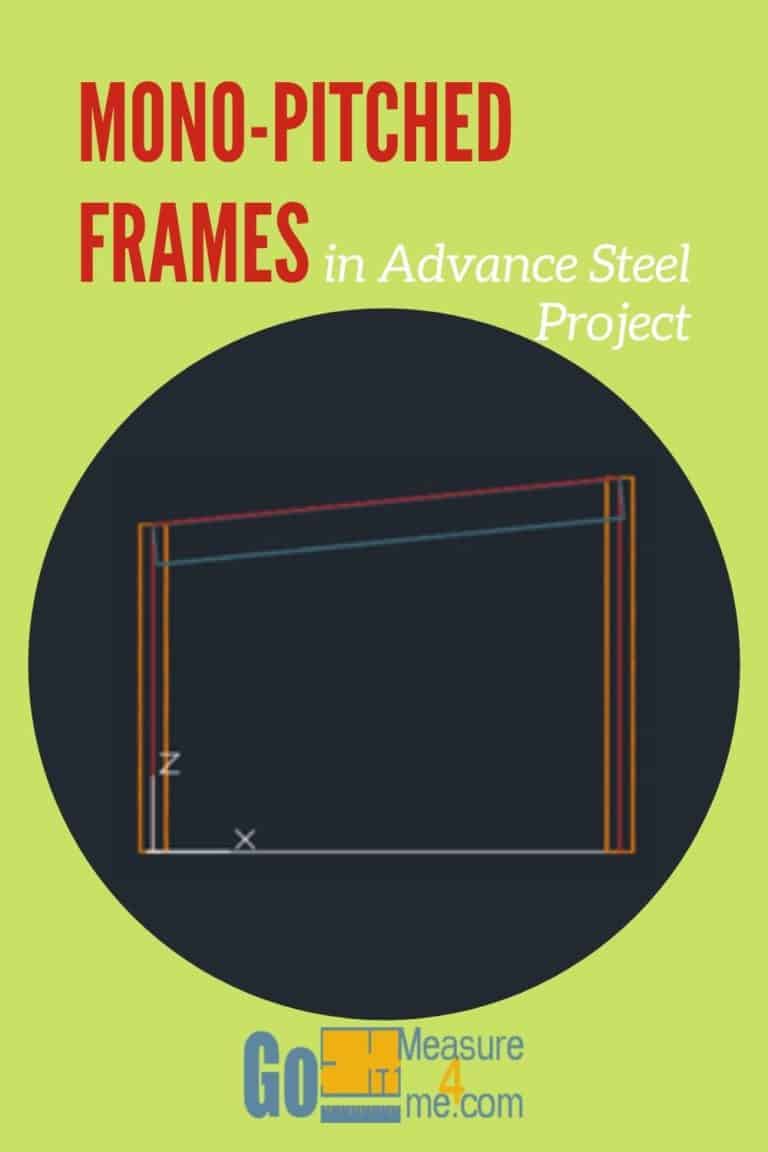
You’ll find the Mono-Pitched Frame tool next to Portal/Gable Frame, on the Home tab:

or on the Extended Modeling tab:

The tool asks for the base point of the first column and the top point of the second column.
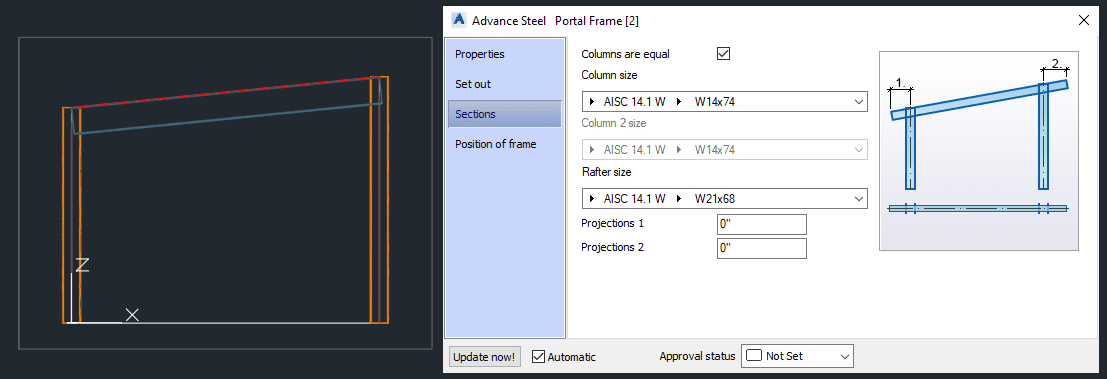
Set Out
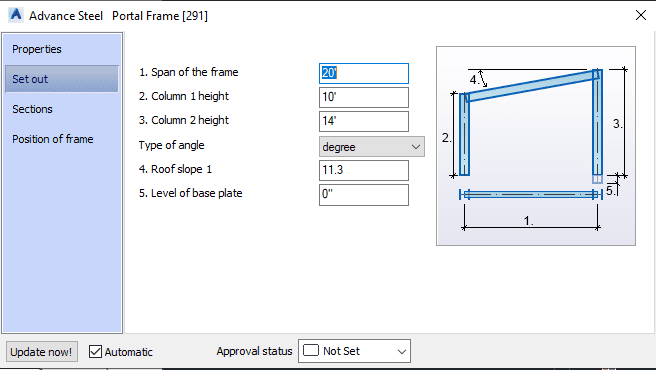
To change the size of the frame, use the Set Out tab. You can adjust the span, the column heights and the slope:
Position of Frame
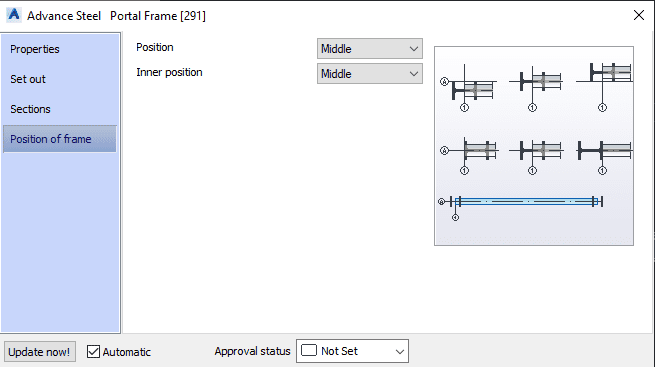
Like on the portal frame, this tab sets where the columns and rafter sit relative to the points you picked.
How do I connect the frame members?
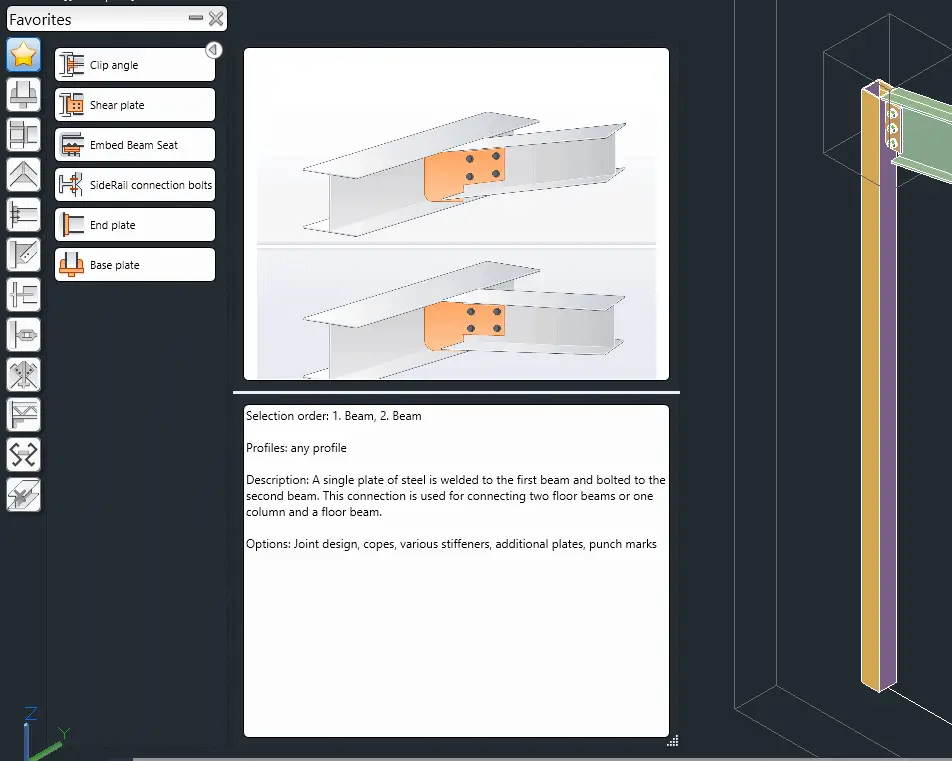
To connect the columns and rafter, use the connections in the Connection Vault on the Home tab of the ribbon:

How do I change a frame after I create it?
Because the frame is controlled by its connection box, you can reopen the dialog and change the span, heights, slope or sections, and the members update. If the box has been deleted, the members are just separate beams, and you’ll have to edit them one by one.
How do I build a whole building with frames?
A common approach is to create one frame on the first grid line, set it up fully, then copy it to the other grid lines, using gable frames at the end walls. Set up your grid first so you have exact points to pick. See all about grid lines in Advance Steel.
The frame tools give you the main members. Bracing, purlins, girts and connections are added separately.
What to do when the frame doesn’t come out right
The columns are shorter than expected. Check Level of base plate on the Set Out tab. The columns get shorter by that amount.
The frame sits off the grid line. Check the Position and Inner position settings on the Position of the Frame tab.
I can’t set different heights on each side. Uncheck Symmetrical Roof on the Set Out tab. The asymmetric settings only become available then.
There are no gable tabs. The Type on the Properties tab is set to portal. Switch it to gable.
The frame fell apart into separate members. The connection box was deleted. Undo if you can, or rebuild the frame.
The frame tools are a quick start for simple buildings. The design itself, member sizes, slopes and connections, comes from the engineer’s drawings, so check anything unclear with the engineer of record.


