Disclosure: this post has Amazon links. As an Amazon Associate I earn from qualifying purchases.


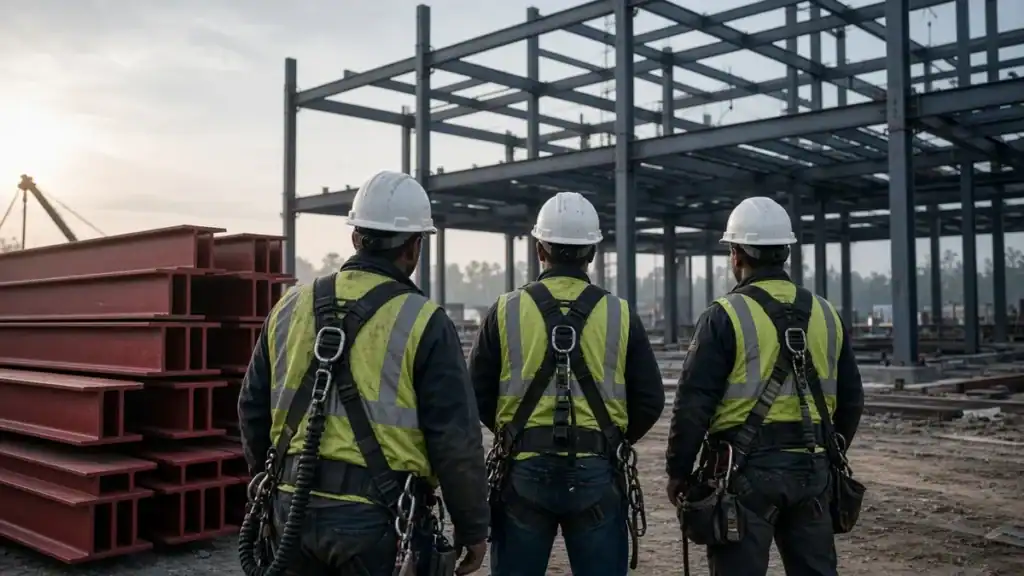
Good toolbox talk topics for a steel contractor are the hazards your crew faces that week: fall protection and connecting, crane signals and rigging, hot work and welding fumes, grinders and eye protection, ladders and aerial lifts, struck-by and caught-between hazards, and weather. Below is a list of topic ideas grouped by hazard, how to run a short weekly meeting that people actually listen to, and the book I wrote with 52 ready-made steel contractor meetings, if you’d rather not write them yourself.
If you run a crew in the steel business, as a PM, a superintendent or a foreman, you know the weekly safety meeting is easy to skip when the schedule gets tight. The hardest part usually isn’t holding the meeting. It’s coming up with something worth talking about every single week.
This list is a starting point for your meetings, not a safety program. Follow OSHA’s current rules (for steel erection, 29 CFR 1926 Subpart R), your company’s written safety program and your site’s competent person.
What are good toolbox talk topics for the steel industry?
Falls and working at height
- Fall protection on steel: when it’s required and how to tie off.
- Inspecting harnesses, lanyards and SRLs before each use
- Anchor points: what you can and can’t tie off to
- Connecting: the connector’s job, and when to stay off the steel
- Controlled decking zones and metal deck
- Openings and holes in the deck: covering and marking them
- Ladders: setup, three points of contact, extending above the landing
- Aerial and scissor lifts: inspection, tie-off, staying inside the guardrails
- Scaffolds: who can build them, and checking the tag
Cranes, rigging and hoisting
- Hand signals and who’s the one signal person
- Inspecting slings, shackles and hooks
- Staying out from under the load
- Tag lines
- Multiple-lift rigging (Christmas-treeing) and when it’s allowed
- Power lines near crane work
- Wind and weather limits for lifts
Hot work and tools
- Welding fumes and ventilation
- Fire watch and hot work permits
- Fire extinguishers: where they are and how to use them
- Grinders: guards, the right disc, and kickback
- Cutting torches and gas cylinder storage
- Eye and face protection for grinding and cutting
- Hearing protection
- Power tool cords and GFCIs
Struck-by, caught-between and everyday hazards
- Falling objects: tool lanyards and barricades below
- Pinch points when landing and bolting steel
- Housekeeping: bolts, scraps and cords on the deck
- Hand injuries and choosing the right gloves
- Lifting and back injuries
- Forklifts and telehandlers on site
- Column stability and anchor bolts before releasing the load line
Health, weather and emergencies
- Heat stress and hydration
- Cold stress and icy steel
- Rain, wind and lightning: when to come down
- First aid kits and who’s trained
- Emergency plan: how to call for help and where to meet
- Reporting near misses
- Chemical labels and safety data sheets (HazCom)
How do you run a weekly toolbox talk that works?
- Keep it short. Ten to fifteen minutes at the start of the shift is enough.
- Pick a topic for this week’s work. If you’re setting deck this week, talk about deck and openings, not something the crew won’t see for months.
- Use one real example. A near miss on your own job or a short news story makes the point better than a list of rules.
- Ask questions. Ask the crew how they’d handle it. The new guy learns more from the experienced ironworker than from the paper.
- Write it down. Date, topic, who led it, and everyone’s signature.
- Follow up. If someone raises a problem, fix it and tell them it’s fixed at the next meeting.
Where can you get ready-made safety meeting topics?
Writing a new talk every week takes time. That’s why I wrote A Year of Engaging 52 Safety Meeting Topics for a Steel Contractor: a full year of meetings for steel contractors, ready to read to the crew.
What’s in my 52 safety meeting topics book?
It’s simple: 52 ready-to-use safety meeting topics, one for each week of the year. The topics cover the things that actually hurt people on steel jobs:
- Hazard identification
- PPE
- Fall protection
- Crane operations
- Electrical safety
- Fire prevention
- Emergency preparedness
Each topic comes with key points and some statistics you can read out to the crew. Numbers tend to get more attention than “be careful out there,” and they give people something to react to and ask about.
Each meeting also has a space for everyone to sign in.
Why does a safety meeting sign-in sheet matter?
The sign-in page is the part worth pointing out to any steel contractor. A signed sheet for every weekly meeting gives you a written record that the training happened and who was there. If there’s ever an OSHA inspection or, worse, an accident, being able to show a year of documented safety meetings is a lot better than saying “we talk about safety all the time.”
Who is the book for?
- Steel erectors and fabricators who hold weekly toolbox talks
- Foremen who are new to running safety meetings and want a structure to follow
- Small contractors who don’t have a full-time safety person writing material for them
It’s not a replacement for a written safety program, site-specific training or a competent person on the job. It’s a tool to make the weekly meeting easier to run and easier to document.
Where to get it
My book is available on Amazon. For OSHA’s own free materials, see osha.gov.
If your crew does detailing or plate cutting too, these might interest them: types of loads on buildings and my first CNC plasma table job.