A level in Advance Steel is a horizontal plane at a set height from the World Coordinate System (WCS), like top of steel at the second floor. When you make a level active, new objects go on it and the UCS locks to it, so beams land at the right height without typing elevations every time. You create levels in the Project Explorer on the Home tab.
It’s worth setting levels up before you start placing steel. Below is where the tool is, how to create a level, how altitude and height work, how levels relate to workplanes and global levels, and what to check when something ends up at the wrong height.
Where is the Create Level tool?
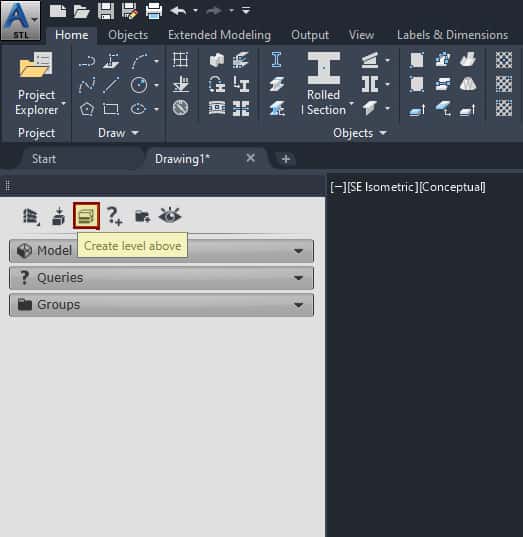
Open the Project Explorer from the Home tab. In the Structures pane you’ll find the Create Level Above tool. Click it and this dialog opens:
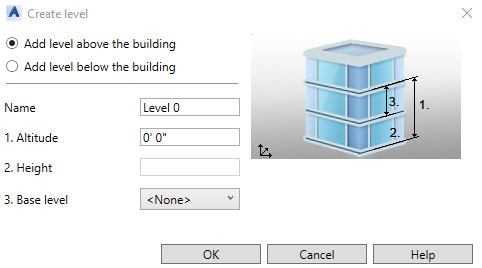
From here you can add levels above or below the structure.
How do I create a level in Advance Steel?
- In Project Explorer > Structures, click Create Level Above. Use the same button for a level below; just pick the Add Level Below the building option in the dialog.
- Type a Name for the level.
- Type the Altitude. This is the distance from the WCS to the new level.
- If this is your first level, the Height box is grayed out and Base Level/Top Level is set to None. Once you have at least one level, you can pick a base (or top) level from the list and give the height of the new level relative to it. The Height box updates automatically from the altitude you entered.
- Click OK. Advance Steel creates the level, slices the model at that level, places a level symbol, and lists the level under Model Views in the Project Explorer.
What should I do when I’m done working on a level?
Click the light bulb next to the level name to turn the level slice off and show the whole model again. Because the UCS was aligned to the level, set it back to World (WCS) afterward. If you forget, the next thing you draw may end up on the wrong plane.
If you want to see levels used on a real job, I set them up step by step in part 02 of my mini tutorial series. Project-wide (global) levels are covered in How to add and edit project global levels.
What’s the difference between altitude and height?
Altitude is measured from the WCS (absolute elevation). Height is measured from the base level you picked (relative). Type one and Advance Steel works out the other. Use altitude when the drawings give absolute elevations, and a base level plus height when they give dimensions from floor to floor.
Levels vs workplanes vs global levels
- Levels are horizontal planes at set heights. Members can be tied to them, so moving a level moves those members.
- Workplanes set the bottom and top levels used when you place columns, as in the mini tutorial parts. See workplanes in Advance Steel.
- Global levels are project-wide datum levels, covered in the global levels post linked above.
What to do when things end up on the wrong level
- New steel is at the wrong height. Check which level is active before you place anything.
- Things are drawn on a tilted or odd plane. The UCS is still locked to a level or face. Set it back to World.
- A level is at the wrong height. Open its properties and check the base level and altitude.
- You can only see part of the model. The level slice is on. Click the light bulb to turn it off.