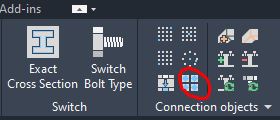
To add bolts in Advance Steel, align the UCS to the face where the bolts go, then go to Objects tab > Connection Objects and pick a bolt pattern: rectangular by two points, by center point, by corner point, or circular. Select the parts to connect, press ENTER, pick the point(s), and set the size, assembly and spacing in the dialog box that opens.
Placing bolts by hand like this is the way to go when you don’t need a full joint between the parts. Below are all four pattern tools, how to switch bolts to holes or anchors, how to edit one bolt in a group, what the assembly abbreviations mean, how bolt length works, and what to check when bolts don’t show up.
Where is the bolt tool in Advance Steel?
You’ll find the bolt tools here:
Objects tab > Connection Objects panel. Select the bolt type, then select the pattern.

NOTE: Align the UCS to the face of the part where the bolt pattern goes before you start. All the pattern tools below place bolts on the current UCS.
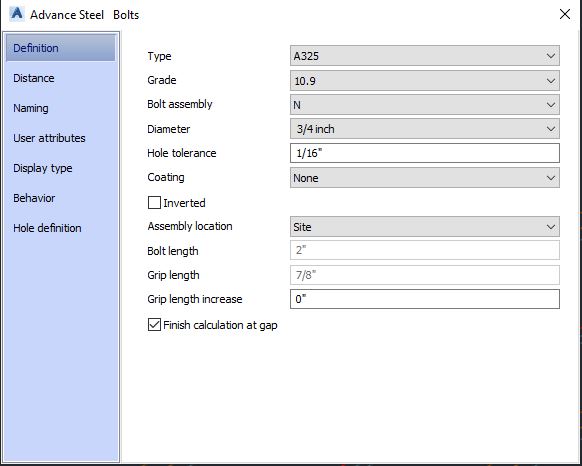
All four pattern tools start the same way: select the parts to connect and press ENTER. What changes is the point (or points) you pick next. Once the bolts are in, a dialog box opens where you set the bolt type, size, distances, naming, behavior, tolerance and so on.
How do I add a rectangular bolt pattern by two points?
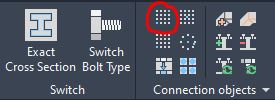
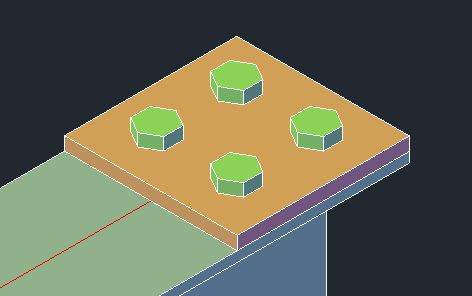
Select the parts to connect and press ENTER. Then pick the lower-left corner and the upper-right corner of the bolt pattern. The bolts are placed and the dialog box opens.
Rectangular pattern by center point
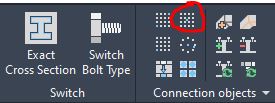
Select the parts to connect and press ENTER. Then pick the center point of the pattern. The bolts are placed and the dialog box opens.
Rectangular pattern by corner point
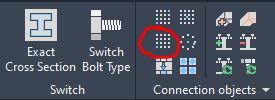
Select the parts to connect and press ENTER. Then pick the lower-left corner point of the pattern. The bolts are placed and the dialog box opens.
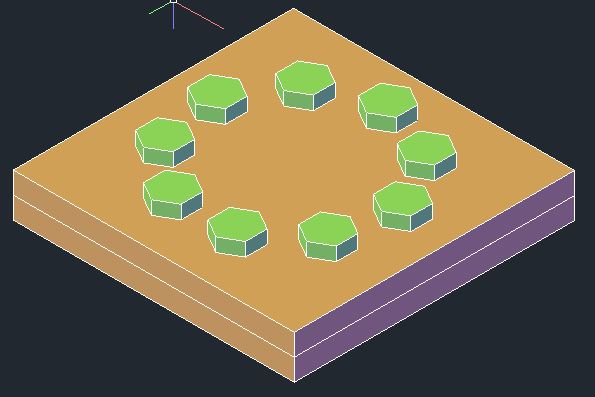
How do I add a circular bolt pattern?
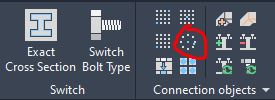
Select the parts to connect and press ENTER. Then pick the center point of the circular pattern. The bolts are placed and the dialog box opens.
How do I edit one bolt in a group?
With any of the methods above, the bolts go in as a group. You can only edit them as a group, not one bolt at a time.
If you need to edit bolts one by one, split the group. Start the tool, select the bolt pattern and press ENTER. The pattern breaks apart into individual bolts. Now you can double-click any bolt and change its properties.
What do the bolt assembly abbreviations mean?
In the bolt dialog box you also pick the bolt assembly. Its name tells you how many nuts and washers go with the bolt: N stands for a nut and W for a washer. Here’s my legend:

| Assembly shown in the legend | Nuts | Washers |
|---|---|---|
| N | 1 | 0 |
| NaW | 1 | 1 |
| NaW | 1 | 2 |
| NaW | 1 | 1 square washer |
How do I change bolts to holes, anchors or shear studs?
Before you place anything, set the object type with the Switch Bolts / Anchor / Holes / Shear Studs button on the Objects tab. Then the pattern tools place that type instead of bolts.
If you already placed bolts, right-click the bolt pattern and change it to holes only or to anchors. That’s handy when the shop drills holes for field bolts that won’t be part of the shop assembly.
What do the settings in the bolt dialog box do?
The dialog box opens as soon as the pattern is placed. The main things to set:
- Bolt type (standard) and diameter. Pick the bolt standard your job uses and the diameter.
- Assembly. How many nuts and washers (see the abbreviations above).
- Distances. The number of bolts in each direction, the spacing between them and the edge distances.
- Tolerance. The hole clearance around the bolt. For standard holes in US work, the hole is usually the bolt diameter plus 1/16 in., per the AISC Specification. Check the project specs for oversized or slotted holes.
- Naming and behavior. How the bolts are named and how the pattern behaves when you edit it.
Bolt sizes, spacing and edge distances are design decisions. Take them from the engineer’s design drawings, and check anything unclear with the engineer of record.
How does Advance Steel figure out bolt length?
Advance Steel calculates the length from the parts you selected: their total thickness (the grip), plus the nut and washers in the assembly, rounded to a length that exists in the bolt database. That’s why selecting the right parts at the start matters. If you miss a plate, the bolt comes out too short.
Why are my bolts not visible?
- The layer is off or frozen. Check the layer the bolts are on.
- They were placed on the wrong UCS. The bolts may be in a different spot or plane than you expected. Zoom extents and look around the part.
- They’re holes, not bolts. If the type switch was set to holes, you’ll only see holes. Check the button on the Objects tab.
- The display is set to hide them.
Common mistakes with bolts in Advance Steel
- Forgetting the UCS. The pattern goes on the current UCS, so if it’s not on the face of the part, the bolts end up at the wrong angle or in the wrong spot.
- Not selecting every part. The bolts only connect (and only count the thickness of) the parts you picked. A missed plate means no hole in it and a short bolt.
- Editing one bolt without splitting. Changes apply to the whole group until you split it.
- Skipping the clash check. Run Advance Steel’s clash (collision) check before drawings to catch bolts that hit other parts or can’t be tightened.
Should I use a joint instead of placing bolts by hand?
For standard connections like shear tabs, clip angles or base plates, a joint from the Connection Vault on the Home tab is usually faster. It places the plates, bolts and cuts together and keeps them linked to the members. Placing bolts by hand is best for one-off situations or when parts just need to be bolted together without a full connection.