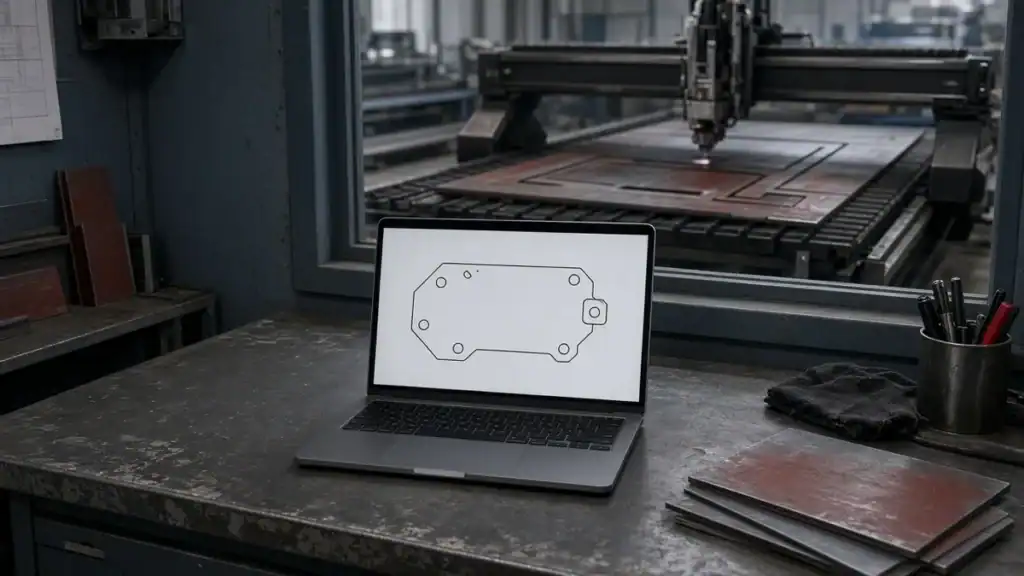
If you detail steel in Advance Steel and the shop cuts plate on a CNC plasma table, you need DXF files of every plate, flat and to scale, that the table software can read. Advance Steel makes them for you from the model.
To export plate DXF files from Advance Steel: turn on “Create one-side only for plate DXF output” in Management Tools (one time), click Update Defaults, run Numbering, then click DXF on the Output tab. The files land in the DSTV NC folder inside your project folder, ready to copy to the plasma table computer.
Below are the full steps with screenshots, plus the difference between NC and DXF files, where the files are saved, what to check before you cut, and what to do when the DXF doesn’t come out right.
How do I export DXF files from Advance Steel?
There are four parts to it: one setting you change once, numbering, the export itself, and finding the files.
Step 1: Change the DXF defaults in Management Tools
On the Home tab of the ribbon, click Management Tools:

A new window opens. Click Defaults in the top right corner:

In the next window, go to the Structured BOM/NC file section and pick the DStV NC&DXF category:

Check Create one-side only for plate DXF output. This way each plate exports as a single flat profile, which is what the plasma software needs.

Load the new setting into Advance Steel with the button in the top right corner:

Close the window, then click Update Defaults on the ribbon, right next to Management Tools. If you skip this, the open model keeps using the old setting.

You only have to do this once. After that, every plate DXF comes out one-sided.
Step 2: Number the model, then export
Make sure you’ve run Numbering before you export. The part marks become the file names, so if you skip numbering you’ll have a hard time telling the plates apart in the table software. Then go to the Output tab and click DXF:

Step 3: Find the plate files
Still on the Output tab, open the Document Manager:

Your plates are listed in the Project Document tree under DSTV-NC-DXF:

Advance Steel also saves them automatically in the project folder on your drive:

Open the DSTV folder and then the NC file folder. That’s where the plate files are. Copy them over to the computer that runs your CNC table software and import them there.

Step 4: Import into the plasma table software
From here the table software takes over. I walk through importing a detailer’s DXF, nesting it and cutting it in Optimum CNC in Slice Like a Pro: CNC Steel Plate Cutting Made Easy.
Why change “Create one-side only for plate DXF output”?
A plasma table cuts a profile: the outside shape of the plate and the holes in it. It doesn’t care that the plate has a top face and a bottom face. With this option on, each plate comes out as a single flat profile, which is what the table software wants. Without it, you can end up cleaning up extra geometry in every file before you can nest it.
Because it’s a default, you set it once and it applies to every project that uses those defaults.
What’s the difference between NC (DSTV) and DXF files?
Advance Steel puts both in the same output category, which confuses people at first.
- DSTV NC files are a text format made for steel fabrication machines. They describe a member (a beam, angle, channel or plate) with its length, cuts, holes and markings. Beam saws and drill lines typically read these.
- DXF files are a drawing format. They describe lines, arcs and circles. Plasma, laser and waterjet software usually reads DXF and turns the lines into cut paths.
So for a plasma table, you normally want the DXF. If your table software can read DSTV NC for plates, ask whoever supports the machine which one they prefer.
Where does Advance Steel save the DXF and NC files?
In your project folder. Advance Steel creates a DSTV folder there, and inside it the NC folder with the files. You can also see them in the Document Manager under DSTV-NC-DXF (step 3 above). Copy the files from the folder to the computer that runs the plasma table software, by USB stick, network share or whatever your shop uses.
Why do I need to number the model before exporting?
Two reasons. First, the files are named by part mark, so without numbering you can’t tell which file is which plate once you’re in the table software. Second, numbering is what tells Advance Steel which plates are identical. That’s how you get one file per plate mark (with a quantity) instead of a pile of duplicates. If you haven’t numbered a model before, read numbering the structural model in Advance Steel.
What should I check before cutting?
Most bad cuts come from settings in the table software, not the DXF itself. Before you hit start:
- Units. Make sure the file came in as inches (or millimeters) and the plate is the right size. A plate that’s 25.4 times too big or too small is a units problem.
- Plate thickness and cut settings. Set the material and thickness in the table software. Wrong settings give a bad edge and can easily double your cut time.
- Kerf. The torch removes material. Let the software compensate for kerf, and if you nest parts tight against each other, leave room for it.
- Small holes. Holes that are small compared to the plate thickness don’t cut cleanly on most plasma tables. Many shops drill those instead. Decide before you cut, and if they’ll be drilled, don’t cut them (or just mark them).
- Lead-ins. Make sure lead-ins start in the scrap, not on the finished edge.
- Quantity. Check that you’re cutting the number of pieces on the shop drawing or BOM.
I learned a few of these the hard way on my first paid job, which I wrote up in My First Cut and First Dollar Using a CNC Plasma Table.
What to do when the DXF export doesn’t work
The DXF has extra lines or both faces of the plate. The one-side option isn’t active. Check the setting in Management Tools, load it, and click Update Defaults with the model open. Then export again.
No DXF files appear. Run Numbering first, then export again, and check the DSTV NC folder in the project folder, not just the Document Manager.
The plate is the wrong size in the table software. It’s almost always units. Check the import units in the table software.
A bent plate comes out wrong. A plasma table needs the flat blank. Plates bent in Advance Steel should be modeled as folded plates so they can be unfolded. See everything about folded plates in Advance Steel.
I can’t tell the plates apart. Renumber, then export again. The part marks are the file names.
How do you make DXF files for plasma cutting without Advance Steel?
Any CAD program that saves DXF will work for simple parts. Keep these rules and the table software will be happy:
- Draw at full scale (1:1), in the units the table expects.
- Make every outline and hole a closed shape: a closed polyline or a circle, with no gaps or overlapping lines.
- Put only cut geometry in the file. No dimensions, title blocks, center marks or text unless you want them engraved or marked.
- One part per file is easiest to manage.
The advantage of exporting from Advance Steel is that the plates come straight from the model, so they match the shop drawings and you don’t redraw anything.