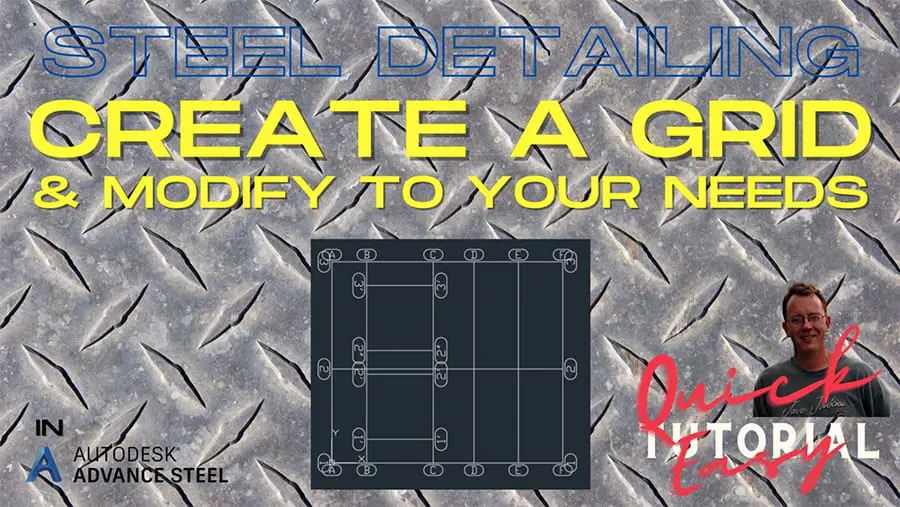
To create grid lines in Advance Steel, go to the Objects tab, click the grid tool in the Grid panel, pick an insertion point and type the overall length and width. Then double-click a grid to set the number of lines and the labels, and switch it to Single axes when you need to move one line on its own to match the plan.
This is Part 01 of my Advance Steel tutorial series for beginners, where I detail a CTA maintenance platform from scratch. The engineer’s plan for this platform didn’t come with a grid, so the first real job is to make one and fit it to the dimensions on the plan. A grid that matches the plan is what everything else snaps to, so it’s worth getting right.
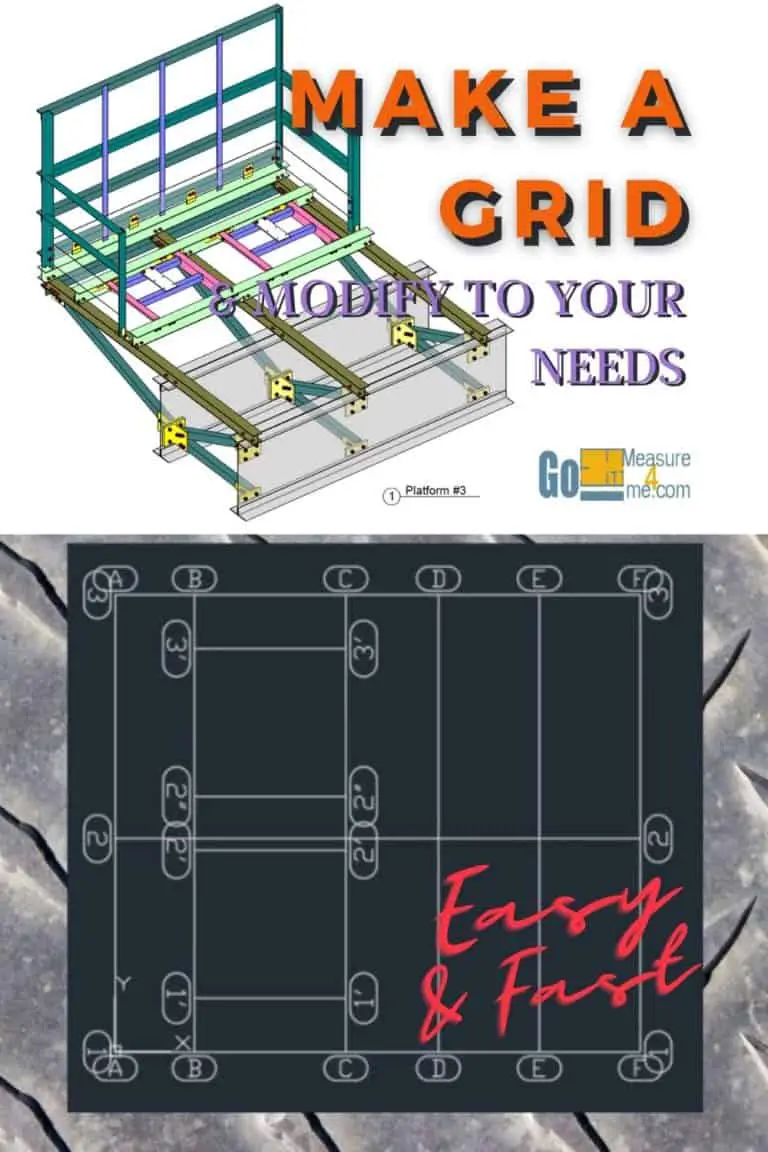
Watch the video walkthrough

You can download the finished project file for free.
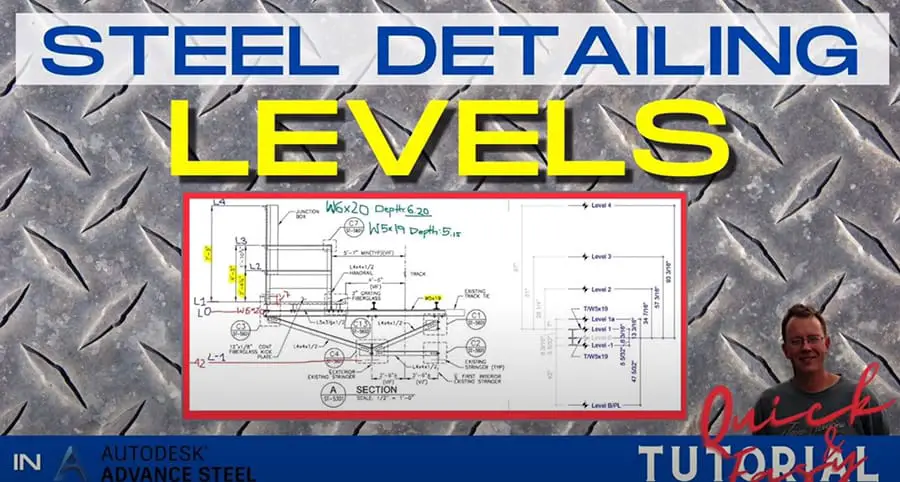
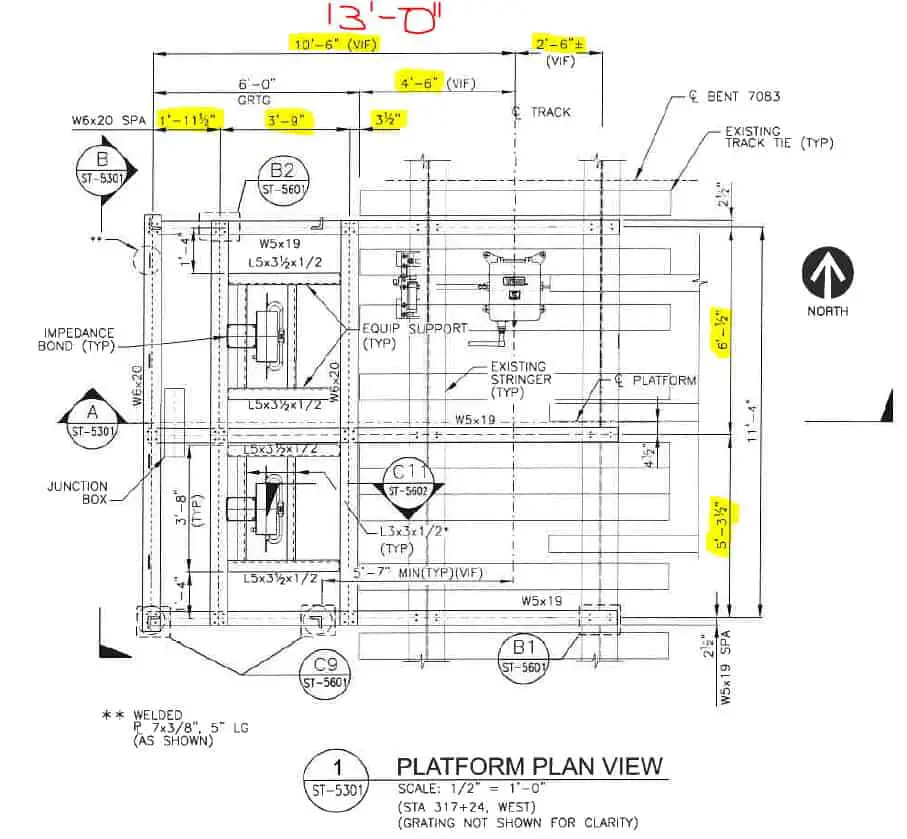
The structure is 13′-0″ x 11′-4″. Here’s the plan, with the dimensions I need for the grid highlighted in yellow:
How do I create a grid in Advance Steel?
- Go to the Objects tab and, in the Grid panel, click the new grid tool.
- Pick 0,0 as the insertion point.
- Type 13′ and press Enter, then 11′-4″ and press Enter. The grid is placed.
- Click Top on the view cube.
Now set up the lettered grids (the vertical lines). Select one and double-click it. In the grid dialog, go to the Group section and enter 6 for the number of grid lines. Don’t worry about the spacing yet, we’ll fix that in a minute. On the Total tab, set the label type to balloon with capital letters. Close the dialog.
Then select a numbered (horizontal) grid and double-click it. This direction only needs 3 lines, so set Group to 3. On the Total tab, set the balloon type to “Ending.” Close the dialog. The main grid is ready.
How do I move a single grid line to match the plan?
Now make the spacing match the plan. I don’t like doing math in my head for this, so I draw temporary lines at the plan dimensions and then measure from them.
- Draw a temporary line 5′-3 ½” from the edge.
- Type
DI(Distance) and click between the line and grid 2. In my case it’s 4 ½”, so grid 2 needs to move 4 ½”. - Double-click grid 2. Under Display Type, choose Single axes and close the dialog. Now you can move one grid line on its own.
- Select grid 2, start Move, point in the direction you want, type 4 ½” and press Enter.
- Open the grid dialog again and set Display Type back to Standard.
Delete the temporary lines. You won’t need them anymore.
How do I add short secondary grid lines?
Do the same thing for the lettered grids: draw temporary lines at the highlighted dimensions, make them long enough to cross the middle of the grid lines, then grab each grid line by its midpoint and move it onto its temporary line. When they all match, delete the temporary lines.
This platform also needs a few shorter secondary grids for the angles: one 1′-4″ from the main grid and one 3′-8″. Draw temporary lines for them on both sides, then:
- Open the axes dialog, switch to single axis, and add the secondary lines on side 2, 1′-4″ apart.
- Check the name of the main axis and add a suffix to the new one.
- The distance from grid 2 to the temporary line is 3 ½”. Add a new grid on that side of grid 2: in the axis index, pick grid 2, set the offset to 3 ½” and change the suffix.
- Do the same for grid 3 with a 1′-4″ offset.
- Finally, check the offset of the last grid. It should be 12 ½”. Adjust it if it isn’t.
If this step is hard to follow in writing, watch it in the video above. It’s much easier to see than to read.
How do I shorten a grid line in Advance Steel?
Delete the temporary lines. The extra grids are still full length, so trim them back:
- On the Objects tab, click the icon with the scissors.
- Select the grid line that stays, and press Enter.
- Select the grid line you want to shorten.
That’s the grid done. Next: 02: Create levels.
Why use temporary lines instead of typing grid spacing?
You can type the spacing straight into the grid dialog. On a plan where the dimensions are all to the same reference, that’s quickest. On a plan like this one, where the dimensions run from different points, drawing temporary lines at the plan dimensions and measuring to them is safer. You see the mistake on the screen before it ends up in the model.
What to do when the grid doesn’t behave
Moving one grid line moves the whole group. Set Display Type to Single axes first, move the line, then set it back to Standard.
The labels are wrong (numbers where you want letters). Double-click the grid and change the label type on the Total tab.
The grid is in the wrong place. Check the insertion point. Starting at 0,0 makes everything easier to find and dimension later.
A secondary grid has the same name as a main grid. Add a suffix to it, like in step 2 of the secondary grids.
Common mistakes with grids
- Not checking the grid against the plan before modeling. Measure a few spacings with
DIbefore you place any steel. - Leaving the temporary lines in the model. Delete them, or they’ll confuse you (and your snaps) later.
- Modeling steel to lines instead of grids. When the grid is right, snapping members to it keeps everything consistent.
For more on grids, see all about grid lines in Advance Steel.
The whole mini tutorial series
- 00: Set up the project information
- 01: Create the grid
- 02: Create levels
- 03: Place beams
- 04: Create columns
- 05: Welded connections
- 06: Shorten beams
- 07: Custom clip angle connection
- 08: Adding bolts to the clip angle connection
- 09: Adding T-braces
- 10: Slanted beams
- 11: Clipping the beams
If you’d like to see the hardware and software I use every day, it’s all on my toolbox page.