To create a level in Advance Steel, go to the Home tab, open the Project Explorer and click Create Level. Give the level a name and an altitude, and click OK. To add one under the current level, switch the option at the top of the dialog to Add Level Below.
This is Part 02 of my Advance Steel tutorial series for beginners, where I’m detailing a CTA maintenance platform step by step. With the grid in place, the next thing to set up is levels. Advance Steel likes every member tied to a level. If you set your levels up front, the model stays organized and you’ll have far fewer headaches later when something changes.

Here’s the step-by-step video:

Follow along with the sample project
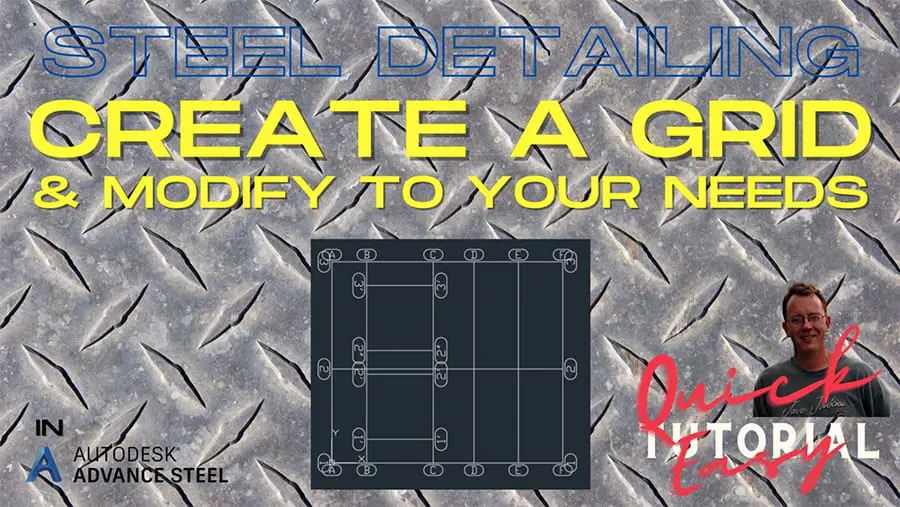
If you want to follow along, download the finished grid project file for free and open it.
How do you decide level heights?
The levels follow the beam sizes on this platform. Keep two numbers in mind:
- A W6x20 is 6.2″ deep (about 6 3/16″).
- A W5x19 is 5.15″ deep (about 5 5/32″).
How do I create a level in Advance Steel?
Go to the Home tab, open the Project Explorer and click Create Level at the top. It doesn’t matter that there are no levels yet.
The Create Level dialog opens. This first one will be Level 0, so I just click OK. A red level mark appears in the drawing.
Add the levels above Level 0
Click Create Level in the Project Explorer again for each of these:
| Level | Altitude (from Level 0) | What it is |
|---|---|---|
| Level 1 | 6.2″ | Top of the W6x20 |
| Level 1a | 13 3/16″ | 7″ above Level 1 |
| Level 2 | 34 7/8″ | |
| Level 3 | 57 3/16″ | |
| Level 4 | 93 3/16″ |
Change the name, type the altitude, click OK. Each new level shows up in red in the drawing.
How do I add a level below Level 0?
- Click Create Level and switch the option at the top to Add Level Below.
- Name it Level -1 and set the altitude to -5 5/32″ (the depth of the W5x19). Click OK.
- Create one more called Level B/PL (bottom of platform) at -47 5/32″. Press Enter.
That’s every level this project needs.
How do I check and change a level’s height?
Click Front on the view cube and you’ll see all the levels in red. Compare them with the original drawing to make sure they match. You can also read the values under Model Views in the Project Explorer.
Made a mistake? Click the level, open Properties, set the Base Level to Level 0, type the correct altitude and click OK. The level moves to the right height.
Why can’t I see my levels?
- You’re in the Top view. Levels are horizontal, so you see them edge-on from the front or side. Click Front on the view cube.
- The level is hidden. Check the level’s visibility in the Project Explorer’s Model Views.
- The altitude is relative to the wrong base level. Open the level’s Properties and check the Base Level.
Common mistakes with levels
- Using the top of concrete or the floor finish when the drawings call for top of steel. Decide what each level means and name it so anyone can tell.
- Rounding beam depths. A W6x20 is 6.2″ deep. If the level is set to 6″, everything on it is 3/16″ off.
- Creating levels after modeling. You can, but then you have to move members to them. Set them up first.
For more detail on how levels behave, see my post on Advance Steel levels.
Next: 03: Place beams.
The whole mini tutorial series
- 00: Set up the project information
- 01: Create the grid
- 02: Create levels
- 03: Place beams
- 04: Create columns
- 05: Welded connections
- 06: Shorten beams
- 07: Custom clip angle connection
- 08: Adding bolts to the clip angle connection
- 09: Adding T-braces
- 10: Slanted beams
- 11: Clipping the beams
If you’d like to see the hardware and software I use every day, it’s all on my toolbox page.